NASA is testing the Artemis 2 rocket again. The launch could take place on 6 March.
NASA will attempt a second test of fuelling the SLS rocket before the Artemis 2 mission on 19 February. After a hydrogen leak in early February, technicians replaced the seals and filter. If the test is successful, the first manned lunar mission sinc
Second attempt after hydrogen leak
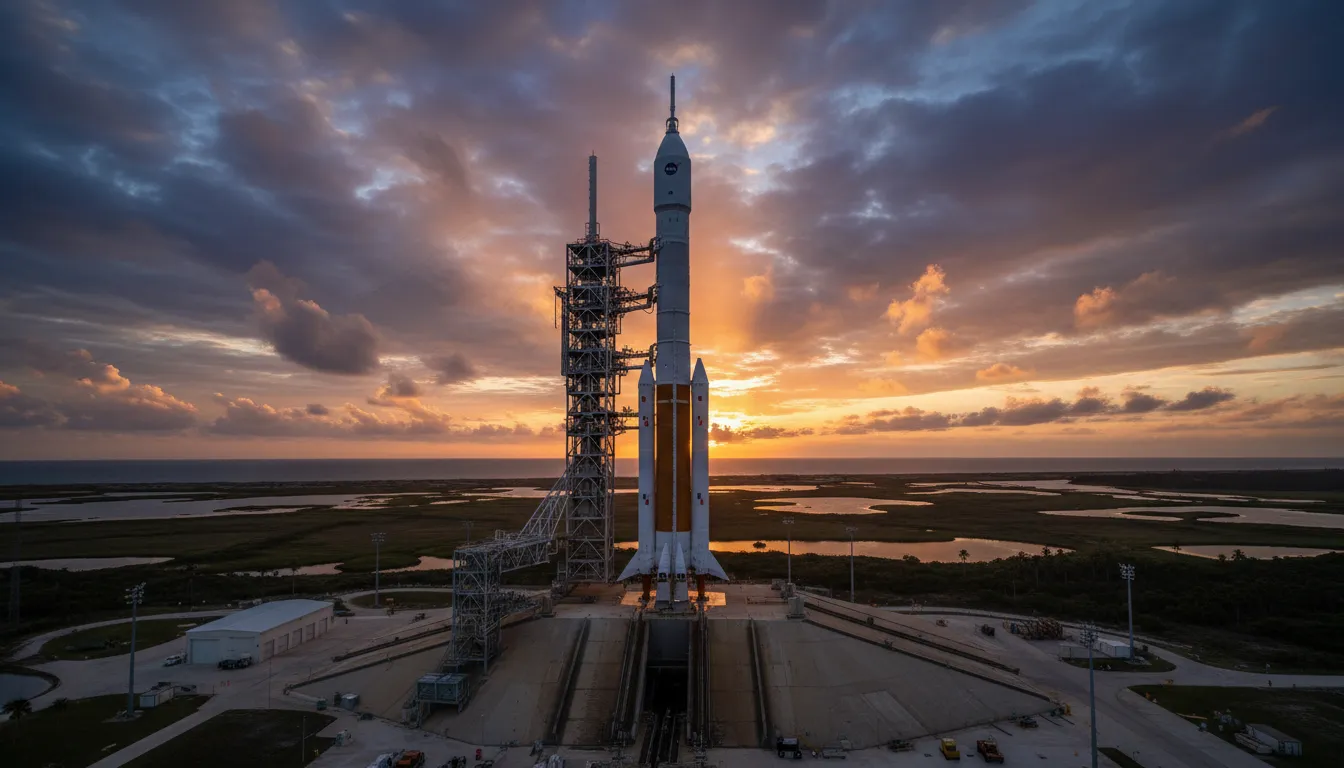
On Wednesday, 19 February, the US space agency NASA will attempt a second wet dress rehearsal — a pre-launch rehearsal in which the Space Launch System (SLS) rocket will be filled with cryogenic fuel and the entire countdown will proceed as in a real launch, but without a crew on board. The countdown is scheduled to begin on the evening of 17 February, with the simulated launch planned for 19 February at 8:30 p.m. local time.
The first attempt took place in early February. The countdown lasted nearly 49 hours and ended approximately five minutes before the simulated launch when the automatic system stopped the sequence due to a liquid hydrogen leak in the tail service mast — a three-storey structure that feeds fuel to the rocket's core stage.
What the engineers repaired
After the first test, technicians replaced two seals at the leak site. On 12 February, they partially filled the tanks with hydrogen to verify the effectiveness of the repair. The seals worked properly, but another problem arose — a clogged filter in the ground equipment restricted the flow of liquid hydrogen into the rocket. Over the weekend, technicians replaced this filter and prepared the systems for a second full-scale test.
During the dress rehearsal, the SLS rocket will be filled with approximately 2.6 million litres of cryogenic fuel — liquid hydrogen and liquid oxygen. The control team will perform two passes of the final ten minutes of the countdown with planned stops at T-1:30 and T-33 seconds, then the countdown will return to T-10 minutes for the second test sequence.
First crew on the way to the Moon since Apollo
Artemis 2 will be the first manned mission to the Moon in over fifty years. Four astronauts will fly aboard the Orion spacecraft: Commander Reid Wiseman, Pilot Victor Glover, NASA Mission Specialist Christina Koch, and Canadian Space Agency Astronaut Jeremy Hansen. The ten-day mission will take them on a free return trajectory around the Moon — further from Earth than any human has been in the last five decades.
If Wednesday's test goes smoothly, NASA could proceed with the launch itself. The agency has identified 6-9 March and 11 March as potential launch windows. In case of further problems, there are backup dates in early April.
Hydrogen problems are nothing new
Liquid hydrogen leaks have plagued the SLS programme since its inception. Similar problems occurred with Artemis 1, an unmanned mission in 2022, when the launch had to be postponed several times due to leaks in the hydrogen connections. Despite NASA applying lessons learned from the previous mission, hydrogen — the smallest molecule — remains extremely difficult to seal at extremely low temperatures of around minus 253 degrees Celsius.
The Artemis 2 mission is also important for Slovakia and Europe because the European Space Agency (ESA) is supplying a key service module for the Orion spacecraft, which provides propulsion, power and life support for the crew. The success of the mission will pave the way for the Artemis 3 programme, which aims to bring the first woman and the first Black person to the surface of the Moon.