Paris Mayoral Election 2026: The Battle to Succeed Hidalgo
With one week to go before the first round on March 15, 2026, three major forces are vying for the Paris mayoralty: Emmanuel Grégoire's united left, Rachida Dati's right, and Pierre-Yves Bournazel's Macronist center. The election carries national significance, coming two years before the presidential election.
A Capital on the Campaign Trail
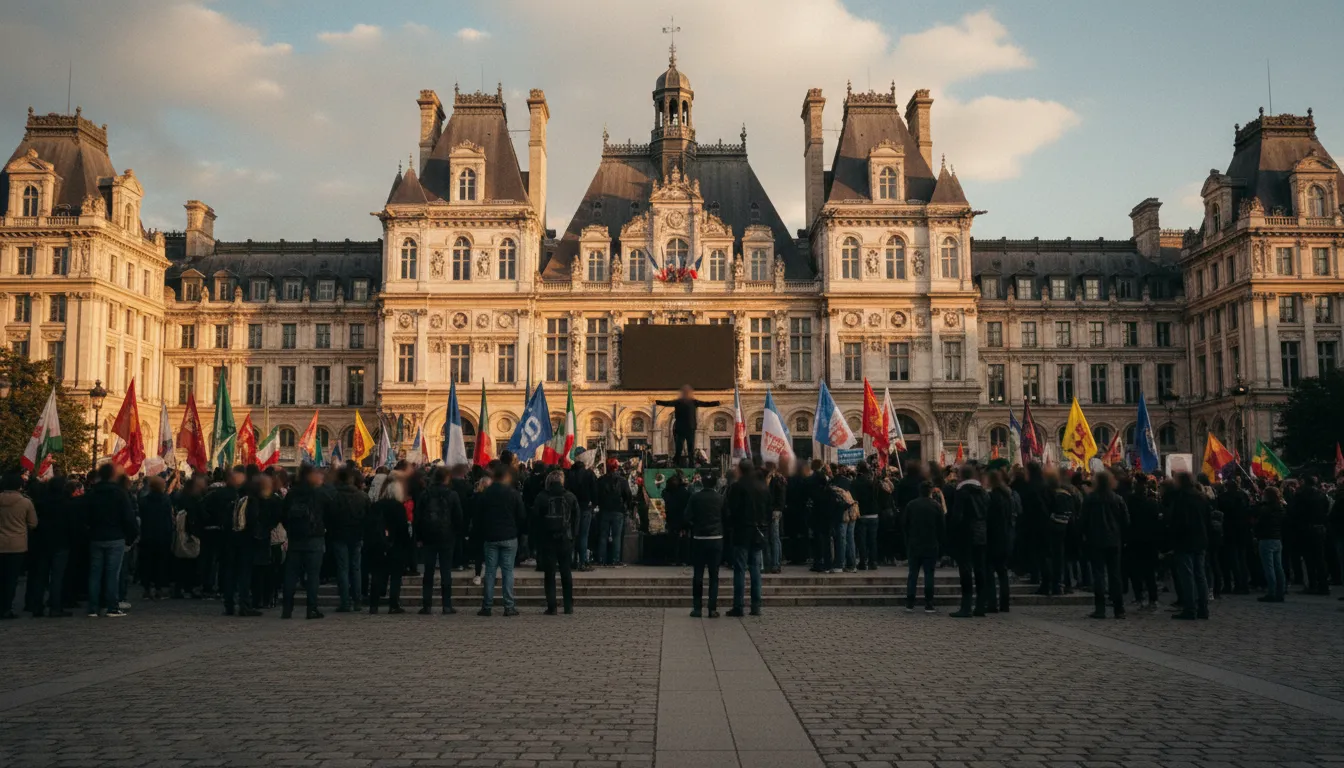
The countdown has begun. On March 15, 2026, Parisians will head to the polls for the first round of the municipal elections, followed by a potential second round on March 22. Since the announcement in November 2024 that Anne Hidalgo would not seek a third term, the race for the Hôtel de Ville (City Hall) has mobilized the entire French political spectrum. Paris, a symbol and showcase of the Republic, is also a laboratory where tomorrow's alliances are being tested.
Three Blocs, Three Visions of Paris
Emmanuel Grégoire, the Heir Apparent of the United Left
Former First Deputy Mayor under Hidalgo, Emmanuel Grégoire is leading an unprecedented coalition bringing together the Socialist Party, the Greens, and the French Communist Party, without La France Insoumise (France Unbowed). This agreement, formalized in December 2025, places David Belliard and Ian Brossat among his lieutenants. Grégoire is banking on the continuation of Paris's cycling policy, promising to address 200 dangerous intersections and continue the transformation of urban mobility. According to the latest Ipsos poll for ICI Paris Île-de-France, he garners 35% of voting intentions in the first round.
Rachida Dati, the Right on the Offensive
The current Minister of Culture and former Justice Minister under Nicolas Sarkozy, Rachida Dati embodies the Republican right (LR). An announced candidate since January 2024, she promises a city that is "clean seven days a week and 24 hours a day" through the privatization of garbage collection, and intends to arm 5,000 municipal police officers, doubling the current workforce. Credited with 27% of voting intentions, she remains Grégoire's main opponent and could surpass him in the second round according to some runoff scenarios.
Pierre-Yves Bournazel, the Centrist Gamble
An elected official from the 18th arrondissement and a figure in Édouard Philippe's Horizons party, officially supported by Renaissance since October 2025, Pierre-Yves Bournazel claims a "third way." With approximately 11 to 14% of voting intentions, he proposes, among other things, 30,000 new parking spaces on the outskirts to decongest the capital. His position as a kingmaker in the second round, should he not qualify, could prove decisive.
An Election with Multiple Stakes
Parisians place security (51%), cleanliness (44%), and housing (38%) at the top of their priorities, according to opinion polls. These themes structure the debates around the arming of the municipal police, bike lanes, and speed limits on the ring road.
Beyond local issues, this election is perceived as a major national test. According to Public Sénat, 72% of French people living in municipalities with more than 100,000 inhabitants believe that "the national situation will count" in their vote. Two years before the 2027 presidential election, Paris is crystallizing the ambitions and strategies of each political family.
The Specter of an Unpredictable Second Round
The unprecedented configuration of this election could lead to a four-way, or even five-way runoff, with Sarah Knafo (Reconquête, 11.5%) and Sophia Chikirou (LFI, 10%) likely to cross the 10% threshold required. In this case, the transfer of votes between blocs would profoundly redistribute the balance of power. The question of alliances—between the center and the right in particular—will constitute the heart of the political suspense in the days to come.
As La Libre Belgique points out, these municipal elections take place in a national context where the Rassemblement National (National Rally) is predicted to make strong gains in many provincial cities, making Paris a symbolic stake for the traditional republican forces. Will the capital vote left for the third time in a row, or will Parisians choose change?