Merz's Arms Buildup: €600 Billion for Germany
Chancellor Friedrich Merz is pushing forward with the largest rearmament program in German post-war history. The 2026 defense budget totals over €108 billion — but industry is already reaching its limits.
Historical Turning Point in the Federal Budget
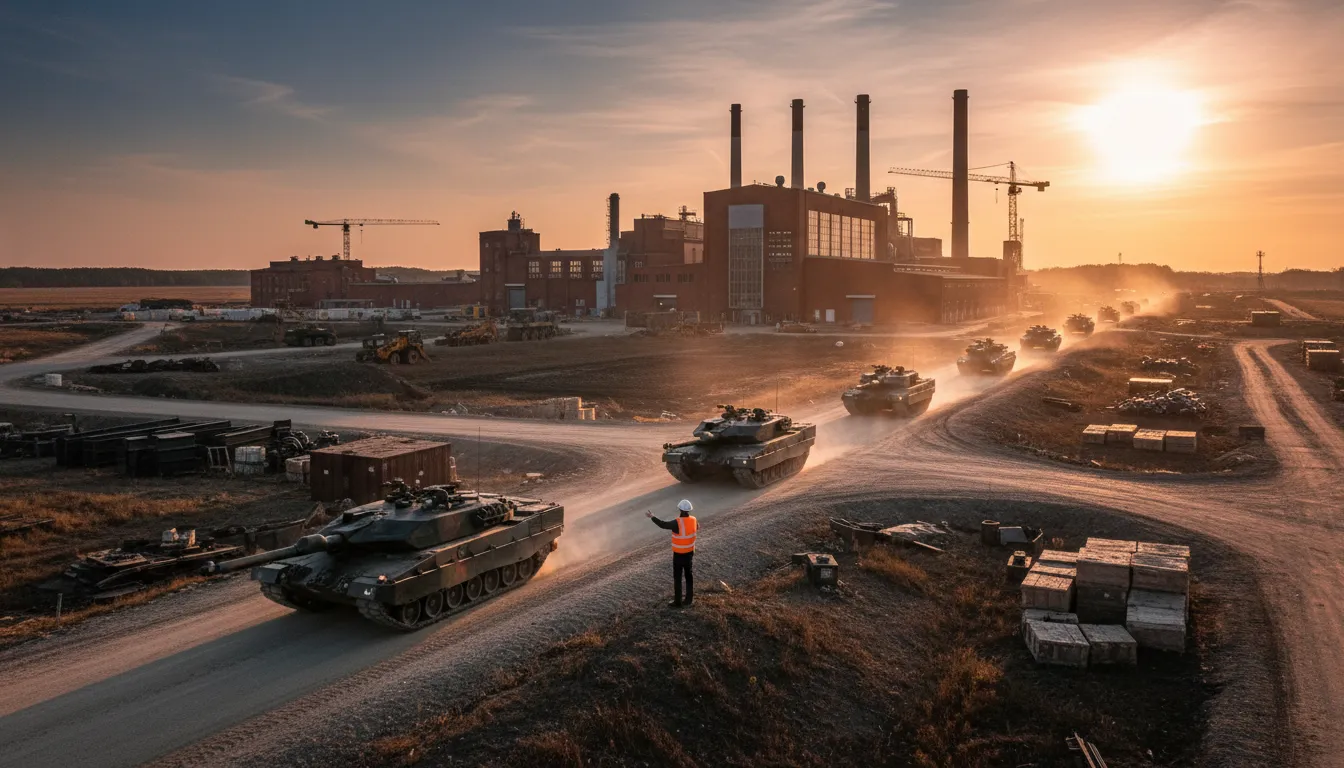
Germany is rearming on a scale not seen since the end of the Cold War. The defense budget for 2026 reaches a record high of €108.2 billion — composed of €82.7 billion in the regular budget line 14 and €25.5 billion from the Bundeswehr special fund. Compared to 2025, this represents an increase of around €21.7 billion. Chancellor Friedrich Merz has effectively suspended the debt brake for defense spending, creating the financial framework for a program that could mobilize up to €600 billion over ten years — provided Germany consistently pursues the NATO target of 3.5 percent of GDP by 2029.
Rheinmetall and the Giants of the Industry
Europe's largest arms group, Rheinmetall, benefits most significantly. The Düsseldorf-based company is targeting a sales increase of 40 to 45 percent for 2026 and holds an order backlog of €63.8 billion. By 2030, the company aims to quadruple its sales to €50 billion and is already expanding aggressively: the number of employees has increased from 23,000 to 31,000 in three years. Diehl Defence also grew from 2,800 to 4,400 employees. The Bundeswehr plans to spend almost €48 billion on arms procurement alone, including €14.8 billion for ammunition — the largest single item.
The Mittelstand Discovers Defense
Away from the arms giants, a quiet structural change is taking place in the German Mittelstand (SMEs). Companies like Hirsch Engineering, previously 95 percent dependent on the automotive industry, have doubled their sales by switching to the arms supply chain — today, half of their orders come from the defense sector. Around 1,350 medium-sized companies in Germany are already active in the defense industry. Even traditional companies such as Bosch and Trumpf — whose founding family once wrote anti-weapons clauses into the articles of association — are now considering entering the segment. The AI industry is also benefiting: start-ups like Avilus are developing autonomous drones for the medical service, with a potential need for over 200 units for the Bundeswehr alone.
Bottlenecks and Structural Limits
But the boom has cracks. Existing production capacities are already fully utilized — a short-term expansion is hardly possible. For 155 mm caliber artillery ammunition, Germany lacks a NATO-compatible 30-day supply; a new ammunition factory in Unterlüß is scheduled to produce around 200,000 shells annually from 2027, but that is not enough. Security checks for new production personnel are further slowing down capacity building. To make matters worse, according to economic analyst Patrick Kaczmarczyk, every euro spent on the military brings at best 50 cents of additional economic output. And: only 48 percent of arms contracts go to domestic manufacturers — almost 20 percent flow entirely abroad.
Can Armaments Save the Economy?
The defense sector employs around 17,000 people in its core area — the automotive industry recently lost 10,000 to 15,000 jobs per month. The structural dimensions are simply incomparable. Analysts warn that the concentration on arms production diverts resources from the urgently needed transformation of industry — for example, in electromobility. The arms program under Merz is historic and necessary from a security policy perspective. However, it is not a panacea for Germany's industrial crisis.