Polish Scientist Discovers 24 Species in the Depths of the Pacific
Dr. Anna Jażdżewska from the University of Łódź led an international team that described 24 new species of deep-sea crustaceans in the Clarion-Clipperton Zone, discovering a new family and superfamily in the process—entirely new branches on the tree of evolution.
A New Branch of Life on the Ocean Floor
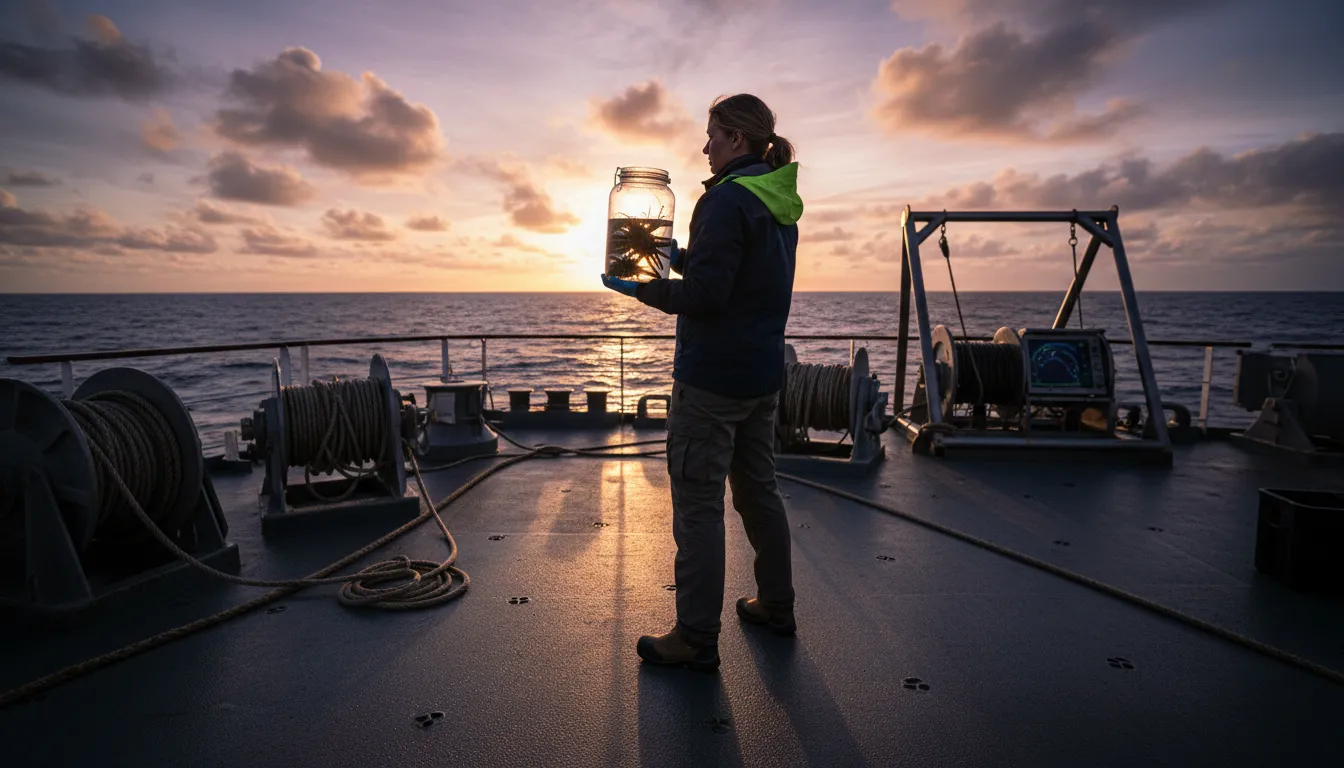
At a depth of over four thousand meters, in the abyssal darkness of the Pacific Ocean, lie organisms that science had no idea existed just a few weeks ago. An international team led by Dr. Anna Jażdżewska from the Faculty of Biology and Environmental Protection at the University of Łódź described in a special volume of the journal ZooKeys as many as 24 new species of amphipods—tiny crustaceans inhabiting the Clarion-Clipperton Zone (CCZ), stretching across six million square kilometers between Hawaii and Mexico.
An Unprecedented Discovery
Among the described species was a discovery exceptional even on a global scale: a completely new superfamily, Mirabestioidea, and family, Mirabestiidae, representing entirely new branches on the evolutionary tree. The species Mirabestia maisie turned out to be so different from all known organisms that it was necessary to create new taxonomic units of a higher order for it.
"The discovery of a new superfamily happens extremely rarely and is incredibly exciting—it's a discovery we will remember," said project co-leader Dr. Tammy Horton from the National Oceanography Centre in Southampton, comparing it to a situation where we already know cats and bears, and suddenly discover dogs.
In total, the team described species belonging to 10 amphipod families, including two completely new genera: Mirabestia and Pseudolepechinella, inhabiting depths exceeding 4,000 meters.
A Collaborative Workshop Model
The success was the result of week-long taxonomic workshops organized in 2024 at the Department of Invertebrate Zoology and Hydrobiology of the University of Łódź, in which 16 specialists and young scientists from institutions such as the Natural History Museum in London, the Canadian Museum of Nature, the University of Hamburg, and New Zealand's NIWA took part. "The workshop collaboration allowed us to achieve an ambitious goal—describing over 20 species new to science in just one year," emphasized Dr. Jażdżewska.
It has become a tradition of the project to give species names honoring researchers: Byblis hortonae is named after Dr. Horton, and Byblisoides jazdzewskae—after the Polish project leader.
A Race Against Mining
The discoveries have implications far beyond taxonomy. The Clarion-Clipperton Zone is one of the world's richest deposits of manganese nodules—minerals crucial for the production of batteries and electronics. Plans for their industrial extraction are gaining momentum: in the United States, the Trump administration accelerated the process of issuing permits by NOAA, allowing simultaneous applications for exploration and extraction licenses.
Meanwhile, data from tests conducted in 2022 showed that after the use of mining machines, the number of species decreased by 37 percent, and biodiversity decreased by almost one-third. "Giving a scientific name gives a species a kind of passport—it allows decision-makers to recognize it as an entity worthy of protection," argued Dr. Jażdżewska in an interview with Inside Climate News.
Over 90 percent of the species inhabiting the CCZ have not yet been described. The research is part of the International Seabed Authority's "One Thousand Reasons" initiative, which aims to formally describe a thousand new deep-sea species by the end of the decade—before the mining industry manages to destroy habitats that science is only beginning to understand.