Charles de Gaulle on Alert in the Eastern Mediterranean
France has deployed its sole aircraft carrier, the Charles de Gaulle, to the Eastern Mediterranean in response to Iran's closure of the Strait of Hormuz, which is driving oil prices above $100 a barrel and weakening European households.
A Strategic Deployment at the Heart of the Crisis
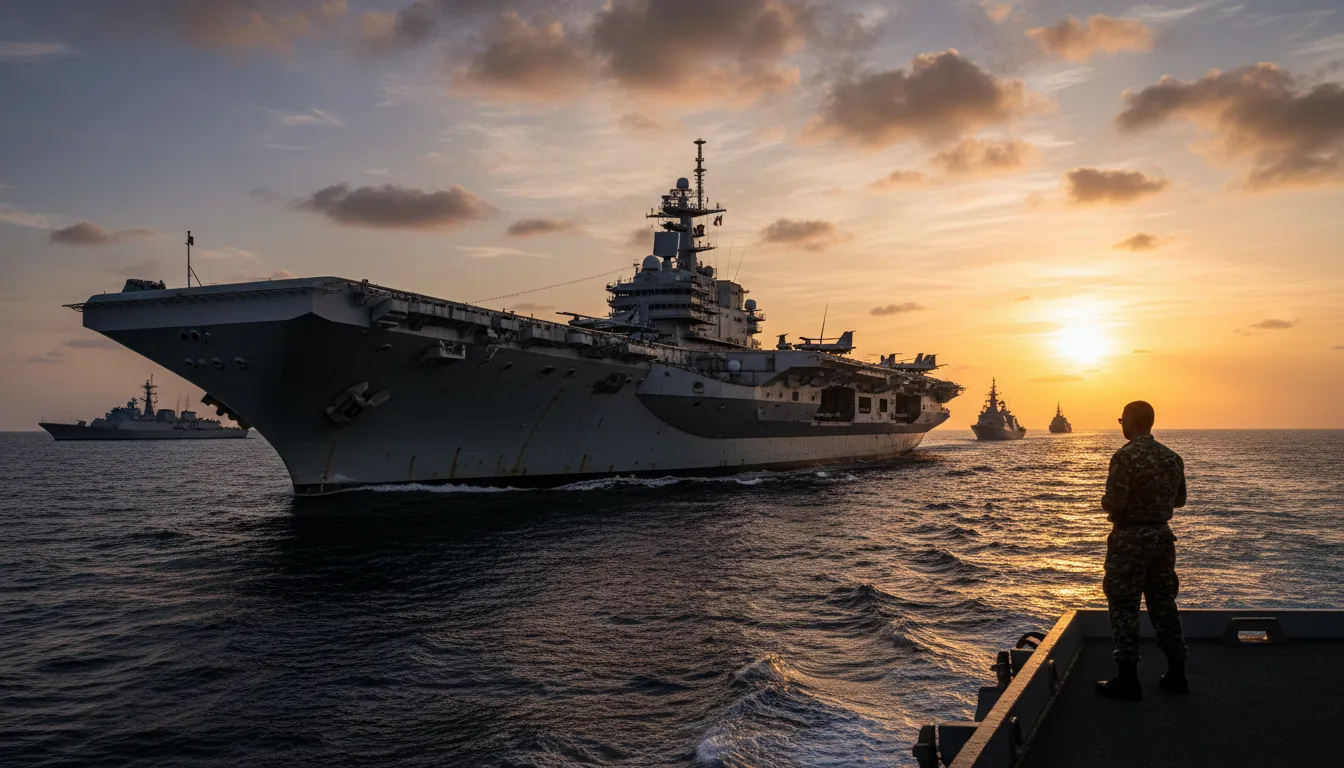
The aircraft carrier Charles de Gaulle (R91), the flagship of the French Navy, has been sailing in the Eastern Mediterranean since the beginning of March 2026, flanked by a multinational naval group of unprecedented size. Announced by Emmanuel Macron on March 3, and confirmed during his visit on board on March 9, this deployment comes amid a military escalation between Iran on one side, and Israel and the United States on the other – a crisis that is shaking global markets and weakening Europe's energy supply.
Initially departing from Toulon on January 27 for exercises in the North Atlantic, the naval group received presidential orders to turn back. On board the Charles de Gaulle: 1,800 sailors, around twenty Rafale Marine fighter jets, two Hawkeye radar aircraft and several helicopters.
A Symbolic European Escort
The European dimension of the deployment is particularly noteworthy. Three allied frigates have been integrated into the French naval group as of March 12: the Dutch frigate HNLMS Evertsen, for which The Hague gave the green light on March 9, the Italian frigate Federico Martinengo, and the Spanish frigate Cristóbal Colón. These ships are operating alongside the French frigates Alsace, Chevalier Paul and Bretagne, as well as the supply ship Jacques Chevallier.
The posture of the naval group is presented as strictly defensive: supporting allies exposed to Iranian reprisals, preserving freedom of navigation and contributing to de-escalation. Paris has expressly excluded any participation in strikes against Iranian territory.
Hormuz Blocked, Oil Ablaze
The economic backdrop is alarming. Since the de facto closure of the Strait of Hormuz – through which 20% of the world's oil and liquefied natural gas transits – the price of crude oil has soared above $100 a barrel. On March 12, the new Iranian Supreme Leader, Mojtaba Khamenei, confirmed his intention to keep the strait closed, raising fears of a prolonged crisis. Analysts are talking about a risk of rising to $200 if the situation persists, which would constitute an unprecedented economic shock for Europe.
For France, as for its Belgian and Swiss neighbors, the impact is already being felt at the pump and on energy bills. Fuel prices have jumped by several cents in a few days, reviving the specter of social tensions.
Paris Between Social Shield and Diplomatic Path
Faced with pressure on purchasing power, Prime Minister Sébastien Lecornu has announced a set of emergency measures: launching 500 inspections at gas stations to curb speculation, considering capping distributor margins, and deploying a new energy voucher targeted at the most vulnerable households. However, the government has ruled out a general price freeze or a VAT cut on fuel, deeming them too costly for public finances.
On the diplomatic front, France is maintaining a line distinct from that of Washington. Macron described the American-Israeli military operations as conducted "outside international law." Paris has also refused to allow its bases in Rota and Morón – shared with Spain – to be used as a support point for strikes against Iran, joining Madrid in a posture of active neutrality that irritates the White House.
Europe Seeking its Way
The deployment of the Charles de Gaulle illustrates the complexity of the French position: an assertive military presence to protect its interests and its nationals in the region, while refusing to be drawn into an open conflict. The challenge is to play a role in the diplomatic resolution of the crisis before the closure of the Strait of Hormuz transforms an oil shock into a lasting recession for European economies.