Poland Withdraws from Ottawa Treaty: Landmines Return
On February 20, 2026, Poland officially withdrew from the Ottawa Treaty banning anti-personnel mines. Prime Minister Tusk announced readiness to mine the eastern border within 48 hours, sparking opposition from humanitarian organizations.
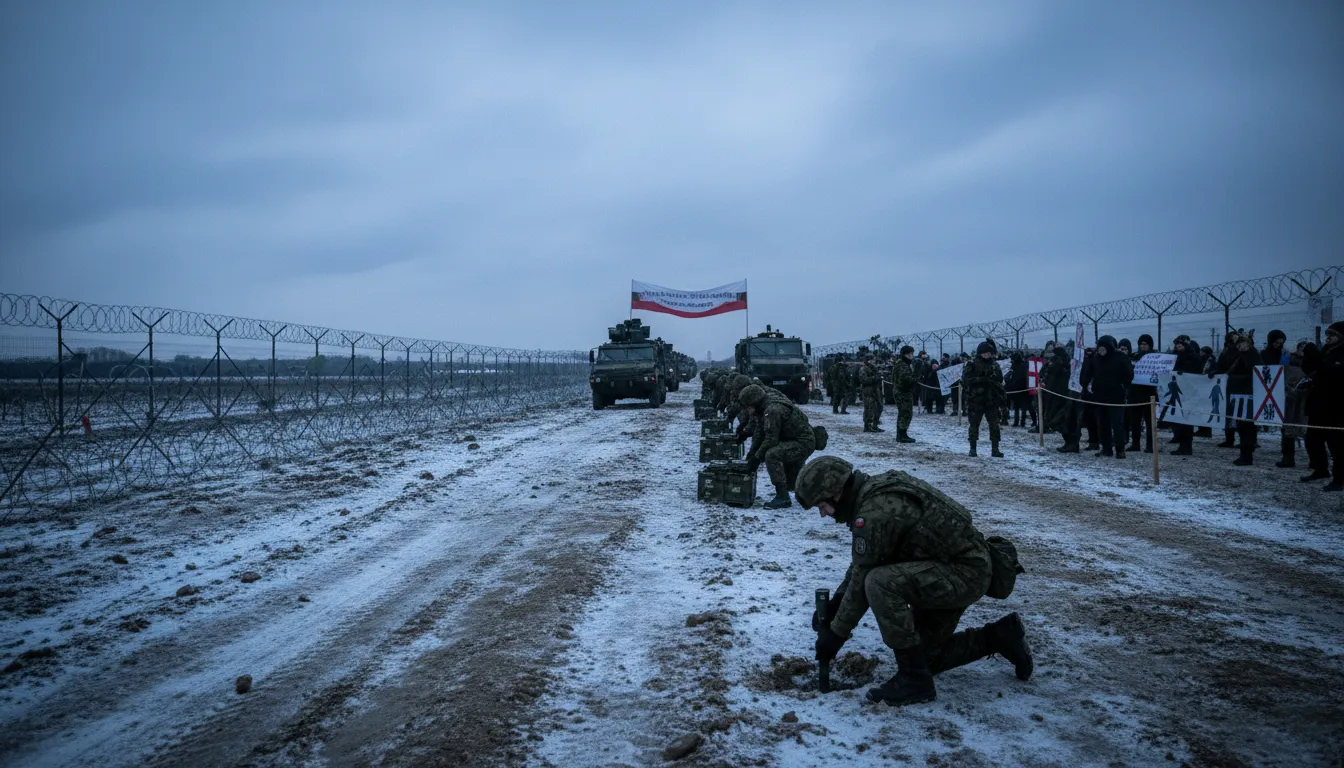
Historic Step: Poland Leaves Ottawa Treaty
On February 20, 2026, Poland officially withdrew from the Ottawa Treaty — a treaty banning the use, production, and stockpiling of anti-personnel mines. The six-month notice period, initiated by Donald Tusk's government in August 2025, has come to an end. Poland became the last of five European countries to leave the treaty in recent months, completing a regional strategic shift with lasting consequences for the security architecture of NATO's eastern flank.
Poland to Seal Eastern Border in 48 Hours
Prime Minister Donald Tusk announced that the Polish military will be ready to mine the eastern border with Belarus and Russia within just 48 hours of a threat emerging. The decision is part of the new defense doctrine of the Shield East program, built around the need to protect a long, partially inaccessible section of the border. The operational tool is to be a modern autonomous mine-laying system called Bluszcz, for which final implementation work is underway. Poland plans to launch domestic production of anti-personnel and anti-tank mines — at the Bydgoszcz Electromechanical Plant Belma and the Radom-based Pronit Company, which are part of the Polish Armaments Group. Some of the mines produced are also to be sent to Ukraine.
Regional Trend on NATO's Eastern Flank
Poland is not alone in this decision. Estonia, Latvia, and Lithuania submitted their instruments of withdrawal to the United Nations in June 2025, and their resignation from the treaty took effect in December 2025. Finland completed the procedure in January 2026. A joint declaration by the defense ministers of these five countries in March 2025 emphasized that the ability to use all necessary means of defense is crucial in the face of Russian aggression and the ongoing conflict in Ukraine. The ministers noted that the decision is a clear signal of readiness to defend territory by all available means. The governments declare, however, that despite the withdrawal, they remain bound by the norms of international humanitarian law.
Critical Voices: "Catastrophic Step Backwards"
Human Rights Watch described the decision as a "catastrophic step backwards for the protection of civilians," pointing out that civilians account for 85 percent of all recorded mine victims, and children — 37 percent of cases where the age of the victims is known. Critics emphasize that by withdrawing from the treaty, Poland joins the ranks of states not bound by the convention — such as Myanmar, North Korea, and Russia — and loses its voice in the forum shaping global policy on eliminating the threat of mines.
Opponents in Poland point to the risk to migrants and refugees crossing the border and the difficulty of controlling the range of mines in the field. Military experts, on the other hand, point out that the effectiveness of mines as a permanent barrier is debatable — modern doctrine assumes their use primarily as an element slowing down an attack, not as an independent line of defense.
Security vs. Humanitarian Obligations
Warsaw's decision reflects a deeper dilemma on NATO's eastern flank: how to reconcile urgent defense needs with long-standing humanitarian obligations. The Ottawa Treaty, signed in 1997, was a product of an era that did not foresee the return of major wars in Europe. Poland consciously chooses security pragmatism, accepting its diplomatic and reputational costs. Whether landmines will prove to be a real deterrent — or primarily a source of long-term danger to civilians after a potential conflict — remains an open question.