Prague Returns 39 Synagogue Textiles to Greece
The Jewish Museum in Prague has handed over 39 synagogue textiles from the Sephardic community of Thessaloniki, looted by the Nazis during World War II, to Greece. This is one of the most significant restitution steps in the museum's history and an important precedent for returning Holocaust cultural heritage.
Textiles from Thessaloniki Synagogues Return Home
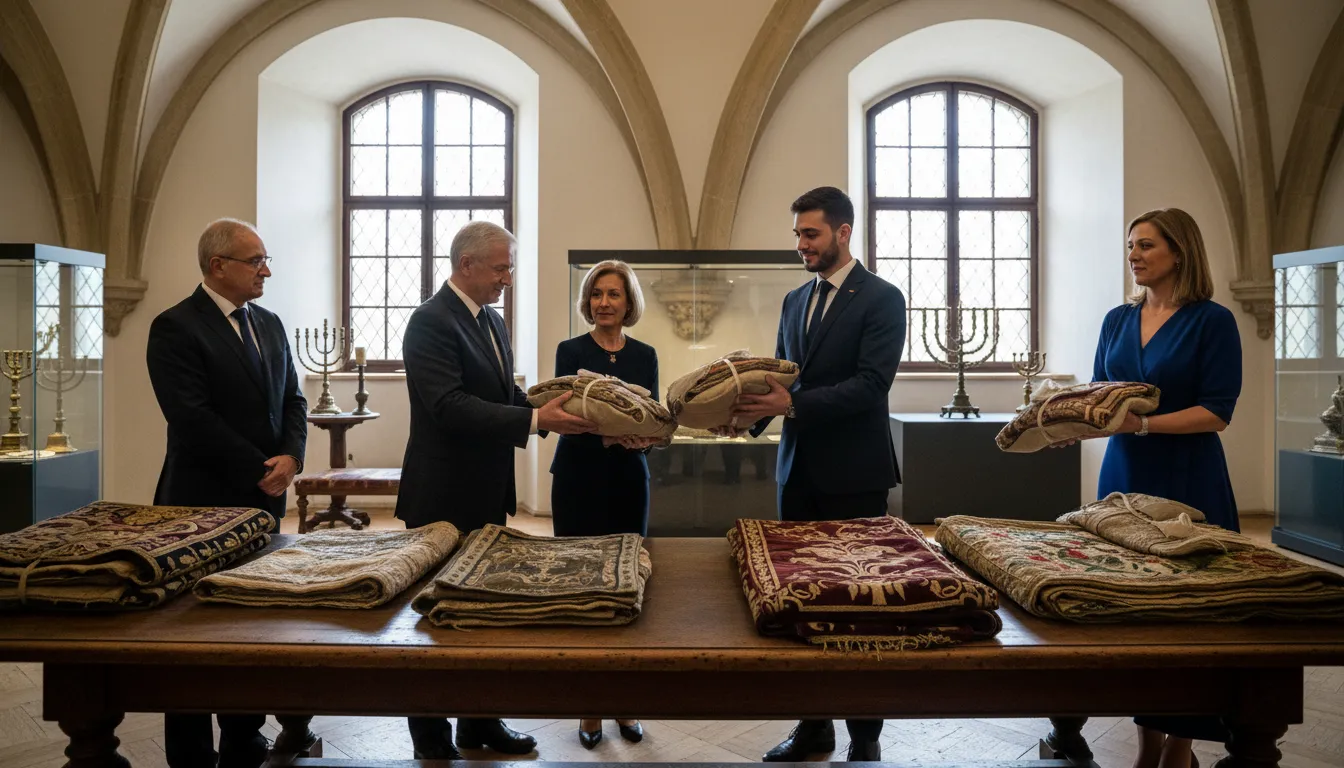
On February 17th of this year, Zanet Battinou, director of the Jewish Museum of Greece, arrived in Prague to receive a collection of 39 synagogue textiles from representatives of the Federation of Jewish Communities in the Czech Republic and the Jewish Museum in Prague. These were curtains, Torah mantles, and synagogue table covers — objects with inscriptions in Hebrew and Ladino, which the Nazis looted during World War II and transported to the territory of what is now the Czech Republic. After eighty years, they are finally returning home.
Thessaloniki: A Center of Sephardic Judaism That Disappeared
The textiles come mainly from the Sephardic community of Thessaloniki. Before the war, Thessaloniki (Greek: Thessaloníki) was home to approximately 50,000 Jews and was the main center of Sephardic Judaism in Europe. After the German occupation in 1941, the Nazis systematically looted synagogues, libraries, and cultural institutions through the so-called Operation Rosenberg. In February 1943, they established ghettos, and from March 15th of the same year, they began deportations: a total of 42,830 Thessaloniki Jews were taken to Auschwitz-Birkenau, with more than 90 percent of them murdered shortly after arrival. The community, whose roots stretched back to the expulsion of Jews from Spain in 1492, de facto ceased to exist.
Four Decades Under the Cipher "Balkans"
How exactly the textiles got to Bohemia is not fully documented — most likely as part of the extensive Nazi transfers of looted property across Europe. The museum registered them in 1954–1956 under the vague category of "Balkans," which obscured their origin for many decades. Only the development of modern provenance research has made it possible to systematically reconstruct the history of specific objects.
"Only in recent years have we been able to return to questions that remained unanswered for decades," described Michaela Sidenbergová, the museum's curator. The result of the research was unambiguous: the textiles belong to the Greek Sephardic community and must be returned.
Moral Obligation, Not a Lawsuit
The handover took place at a time when pressure is growing across Europe to accelerate the return of cultural property looted during the Nazi occupation. Last April, representatives from twelve countries met in The Hague to coordinate procedures for returning looted artifacts. Germany introduced a binding arbitration procedure for property restitution on December 1, 2025, and in the USA, a bill is heading to Congress to permanently extend the HEAR Act, which protects the claims of Holocaust survivors and their descendants.
Prague's step stands out in this context for its voluntariness. It was not the result of judicial pressure, but a proactive recognition of a moral obligation. "It is the fulfillment of a moral duty to return the dispersed heritage," emphasized representatives of the Federation of Jewish Communities in the Czech Republic. The objects will now be taken care of by the Jewish Museum of Greece in Athens.
Exceptional Step in the Museum's History
The Jewish Museum in Prague is one of the largest institutions of its kind in the world and preserves tens of thousands of exhibits documenting the richness of Central European Jewish culture. The handover of 39 Greek textiles represents one of the most extensive restitution acts in its entire history. At the same time, it sends a clear signal to other European museums: provenance research and a willingness to act can redress at least some of the wrongs brought about by World War II — without waiting for a court order.